neozeed
I run virtuallyfun.com
@Rairii awesome work! Does the Wii version run in "Wii mode"? (All RAM, faster CPU)
I'll try it this weekend 
@Rairii
I wanted to try now and discovered that my black Wii doesn't have GameCube ports 
So that's as far as I can get 
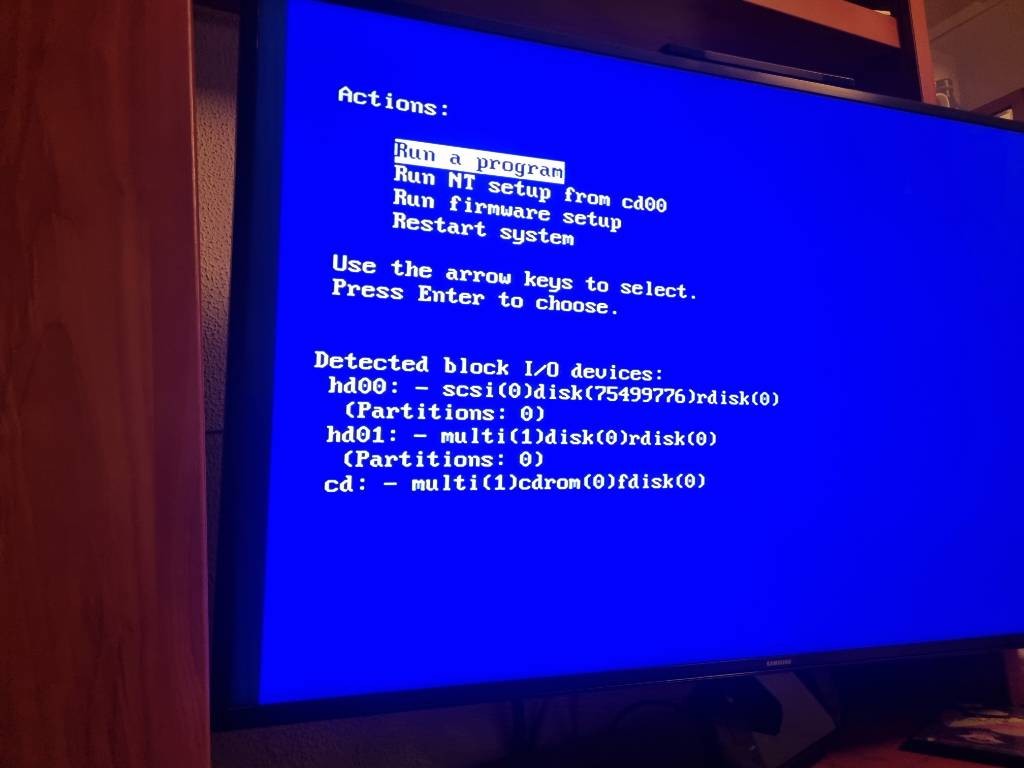
Alt...
A big tv showing the blue screen of the arc firmware, with text:
Actions:
Run a program
Run NT setup from cdoo
Run firmware setup
Restart systen
Use the arrow keys to select
Press Enter to choose
Detected block I 0 devices:
hd00: - scsi(0)disk(?5499??6)rdisk(0)
(Partitions: 0)
hd01: - multi(l)disk(0)rdisk(0)
(Partitions: 0)
cd: - multi(1)cdrom(0)fdisk(0)
S
@Rairii at long last, it is now theoretically possible to use Windows using a fishing rod

 boosted
@winload_exe @Rairii brb installing microsoft exchange on my nintendo wii and launching a fishing attack with my phishing rod 🎣 
Friday will be here soon enough!

Microsoft is paywalling features in NOTEPAD. Let me say that again so it sinks in. Microsoft is _paywalling_ features in _NOTEPAD_.
My god this is so stupid.
Noteapd is my "IDE" and I really dislike the uwp thing, so I do my best to avoid it.
I don't know how you can scew up repeat search/replace, but MSFT found a way.
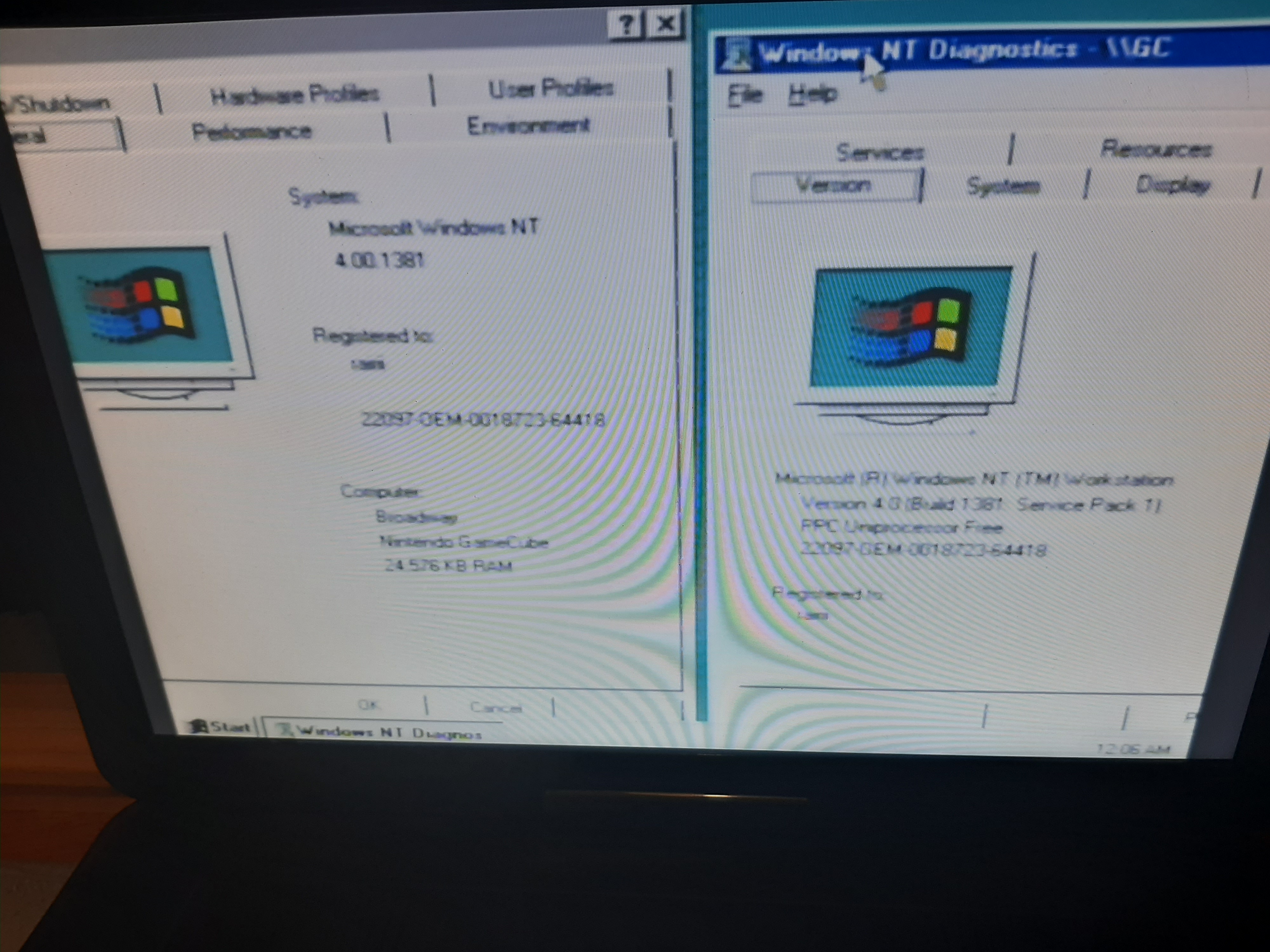
Alt...
Picture of a portable dvd player with av in and a large screen, showing NT 4 running. System Properties specifies CPU "Broadway" and system "Nintendo GameCube", with 24,576 KB RAM; Windows NT Diagnostics shows the running kernel is "PPC Uniprocessor Free"
With all the attention I've given the Mitac Paragon 88 Turbo XT lately, I guess its time the Ugly 286 was finally given some. While it may be a little rusty, yellowed, and have "Tasman" engraved in the plastic, its not a bad machine overall.
Current specs are: 12MHz 286, 10MHz IIT 2C87 FPU, ST-238R RLL HDD (on an MFM controller for some reason, so only formatted as 20MB rather than the full 33MB), 2MB RAM, and some Trident VGA card. The yellow FDD is 1.2MB, while the black one is 360K.

Alt...
They ugly 286: yellowed, a little rusty, and has "Tasman" engraved in the plastic on the top along with the ASCII code for the Pi character written in pencil on the front!
I went digging and these are the parts I found. I'll probably regret the NIC choice; it looks suitably old for the machine, but old usenet posts suggest it may not be quite as NE2000-compatible as it could be.
I've no idea if the RAM works, but I don't think I have any other machines that take this kind, so it may as well go in if it does.
And a black 1.2MB FDD to match the existing 360K drive (not that there is anything wrong with the existing 1.2M drive aside from being yellow not black).

Alt...
Upgrade parts all bagged up except for the FDD - I was using it recently on a Greaseweazle

Alt...
Parts unbagged. The sound card will need some CMS chips eventually.
Well, I regretted that NIC for an entirely different reason than anticipated. After the machine had been running fine for 10 minutes or so, I briefly stepped out of the room only to come back to smoke pouring out the computer.
Thankfully the computer is totally fine - no damage to the cards on either side of the NIC and everything else tests OK.
I expect the cause was probably one of those blue tantalum capacitors - there *was* one right in the middle of the black mess.

Alt...
One American Research PCN-006 network card that will never network again
Due to the NIC failure, I had to go digging for an alternate and ended up with an 3Com EtherLink III. A little newer than I'd like, but I don't have all my ISA NICs here with me.
I had to switch to a different unfortunately somewhat newer (33.6k) modem too due to space constraints. The 14.4k modem I had before interfered with the RAM slots, and a few other smaller 14.4k modems had issues (couldn't hear the dialtone, or couldn't establish a connection for some reason)


So this is what the inside looks like now with the new cards installed. The left-most slot, and the two right-most slots are only 8-bit ISA so only the SoundBlaster 2.0 or modem would fit there, but the SoundBlaster is too long for any of those slots. The SIP memory and HDD means only short cards in the three 8-bit ISA slots.

Alt...
Inside of the computer with new cards installed.
What started with a "lets make the floppy drives the same colour" turned out to be a bit more of an ordeal. The black 360K Chinon FZ-502 drive already in there turned out to be no good, so I set out to replace it with a slightly older Chinon F-502L II.
But this drive would only step the heads once during the seek test and again while booting. Couldn't read disks at all. Almost gave up on it, but decided to try cleaning the PCB edge connector. Now its works nicely.

Then the 1.2MB Pansonic JU-475-3A14 I wanted to replace the old yellow 1.2MB drive with was misbehaving. I was sure I'd used this drive recently with a greaseweazle but now it couldn't seek properly past the middle of the disk. It would just start jumping grooves on the worm gear.
After cleaning the worm gear a bunch and helping the heads travel the full length of the disk, the drive is now working fine too. The ROM-based diagnostics were helpful in verifying that all was working as it should.


So after all that, the ugly 286 now at least has matching floppy drives, and both of them even work too! 1.2MB on the top, 360K on the bottom.
Still a few things left to do on it (like figuring out how to switch turbo on and off, and making the power LED work), but this is enough for one night I think.

@neozeed Yeah, after this tantalum on a Socket 8 board shot glowing shrapnel into the air one piece of which left a burn mark on a piece of paper nearby I started thinking perhaps some eye protection is a good idea when powering up old stuff for the first time. That and doing it outside so I don't smoke out my office!
Old CRTs I'm the most nervous about powering up for the first time, though I don't know why as I don't think I've ever had one do anything exciting.

I'm just happy to still have the board.

Alt...
Harris 25Mhz 80286 & 80287XL
| But my state media compells me to sharecrop culture!: | 0 |
| Always own!: | 0 |
| CeX Rox!: | 0 |
| I don't even own a functional optical drive: | 0 |
| I've got a mountain of cassettes: | 0 |
| Ha a tonne of vinyls : | 0 |
| Reel to reel, baby!: | 0 |
| I just download FLACs from archive.org: | 0 |
Closed
Either way it's nice to have a differencing disk image that won't get destroyed, and a couple seconds from execution to login prompt.
Now the real question is, should I even try to building something with it?
While the GMA900 never set the world on fire, in terms of OpenGL performance, it's enough for simple stuff like ssystem.
The ultimate question: HOW WAS YOUR SOUNDBLASTER(/clone) CONFIGURED?
| 220,5,1: | 206 |
| 220,7,1: | 106 |
| Something else/I used something not SB compatible: | 15 |
| I never used a soundcard under DOS: | 123 |
But then again, I'm the madman that wired up the turbo button so when it was engaged/lit the CPU ran at maximum speed. Apparently Turbo means slow mode.
The Mitac Paragon 88, a rather nice compact 10MHz Turbo XT. Integrated Paradise CGA video, RTC, Floppy controller, one serial port, one parallel port and 768K RAM (the top 512K-640K is bank-switchable to support a 128K RAM disk). Display is an ADI DM-14+ green monochrome. In 1988 with the 20MB Seagate ST225 hard disk, this thing would have cost somewhere in the region of NZ$10k in todays money.

As its 2025, I guess its about time this thing finally got online. I had a dig through the big box of modems, and this one seems suitable enough! A little newer than the computer itself, but it doesn't really look it. Fits right in between the NIC (a far more sensible connectivity option), and the Transteque MFM disk controller for the ST-225 20MB HD

Alt...
Mystery 8-bit ISA dialup modem

Alt...
Modem installed in the computer between the NIC and MFM disk controller
Checking RNZ News at 2400bps! Its not fast, and RNZ is not as compatible with text-mode browsers as it perhaps could be. But it made horrible screeching noises as it connected and that's the important thing! https://www.youtube.com/shorts/DCfbWiuM7b4
I used to get booted from all the local BBS's as I was too slow, but I was so thrilled to step up from 1200 baud.
@neozeed I guess by '92 14.4k modems were probably taking over! I was thinking as I heard this modem dial for the first time it probably hasn't been used since the early 90s; I can't imagine 2400 baud would have been at all useful for internet access when that started to become available to the public so it was probably exclusively used for accessing BBS in the past.
I guess its why building mach wasn't so scarry.
It took a while but eventually I did get a 9600 baud 'field upgradable/dsp' modem that sometimes could 14.4 but it mostly did 9600 which I was still amazed with. It's also back when people would meet in person to swap disks, and then eventually I'd help other people install Linux into those linux install parites. And OS/2 as well, well before NT 3.5
One last upgrade for the Mitac: a second serial port. In part because I can't think what else I would put a one-port serial card in and I have two of them lying around. This leaves it with one 8-bit ISA slot free, maybe for a sound card someday - one of those adlib clones perhaps, though they're a little on the expensive side.

Alt...
Single port serial card ready to be installed

Alt...
Rear view of the Mitac Paragon 88 with the card installed in the second slot from the right. The left-most slot doesn't accept cards.
I mirrored it and fixed the pathing issues so it works again: https://virtuallyfun.com/pdp11/
I thought it was pretty cool though, shame to leave it broken.


Alt...
Are you sick of being spied on by those pesky intelligence agencies? Do you want a laptop that is simultaneously completely secured due to the Intel Management Engine being fully removed (no one can spy on you!) and also fully vulnerable to Spectre? Look no further, this is the laptop for you.
Jokes aside, this is an amazing little laptop, way ahead of its time. I bought it during lockdown as a bit of a hobby, I wanted to learn how to refurbish a laptop and flash a BIOS straight on the chip. Somehow I was very successful.
I actually daily drove this for a while, it's a great little piece of kit, fine for general web browsing and dealing with documents, files etc. But since I'm a genius, I decided to run Gentoo. Given it's an old laptop, I spent most of the time compiling. It won't ship with an OS, don't worry, you can use binaries.
The laptop is overall in very good condition, apart from the outside of the top and bottom. I have a theory that the person I bought it from fished it out of a dumpster. I took the whole thing apart and cleaned it up completely, but there are some scuff marks, see the pictures, it's not that bad though. To perfect this little laptop, which is almost a collectible at this point, you could just replace the shell.
Oh and the battery condition isn't great. It's the 9 cell battery but it's some knockoff and might give you an hour if lucky. The charger also has an EU plug for some reason and isn't genuine but works perfectly fine.
Everything on the laptop works (as far as I know anyway), even the little light on top the screen.
Why am I selling this amazing laptop you might ask? Maybe I'm from the GCHQ and I'm trying to compromise privacy conscious citizens, or maybe I'm just moving out of the country and I need to get rid of anything I can, you decide.
Do feel free to send me any questions if you have them, happy to answer them.
THE SPECS:
- Core 2 Duo 8600p
- HP 2x 4GB DDR3 RAM
- Atheros AR5B95 WiFi Card (FULLY OSS DRIVERS!)
- 12.1" 1280x800 WXGA Screen (NEW)
- US Keyboard (NEW)
- 9-cell battery (TOTALLY NOT GENUINE)
- New charger (EU PLUG, NOT GENUINE)
- Coreboot SeaBIOS (the version is a couple of years old but works fine)
It's basically as good as it gets for this model, everything that I could replace or upgrade has been upgraded and replaced pretty much.
boosted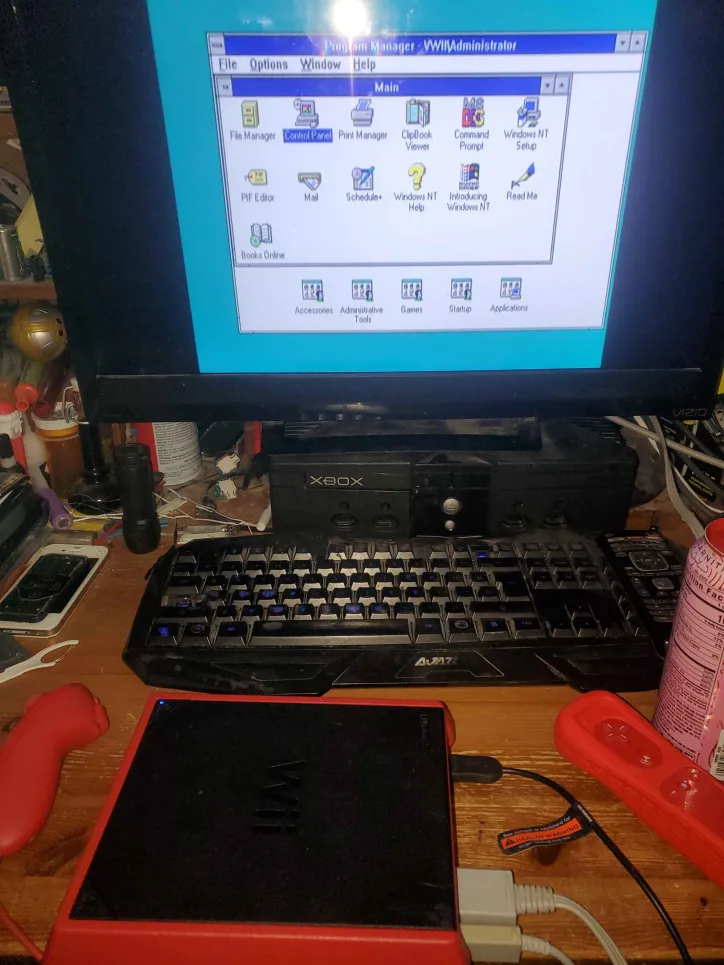
Alt...
Windows NT 3.51, with the computer name "VWII", shown on a TV screen, below that is an OG xbox and next to that is a keyboard, also in the frame is the wii mini that NT is running on, with USB, power and video cables plugged in and extending out of frame, a red wiimote is next to the wii mini on one side, and nunchuk on the other.
History